The 2012 project – a brief update

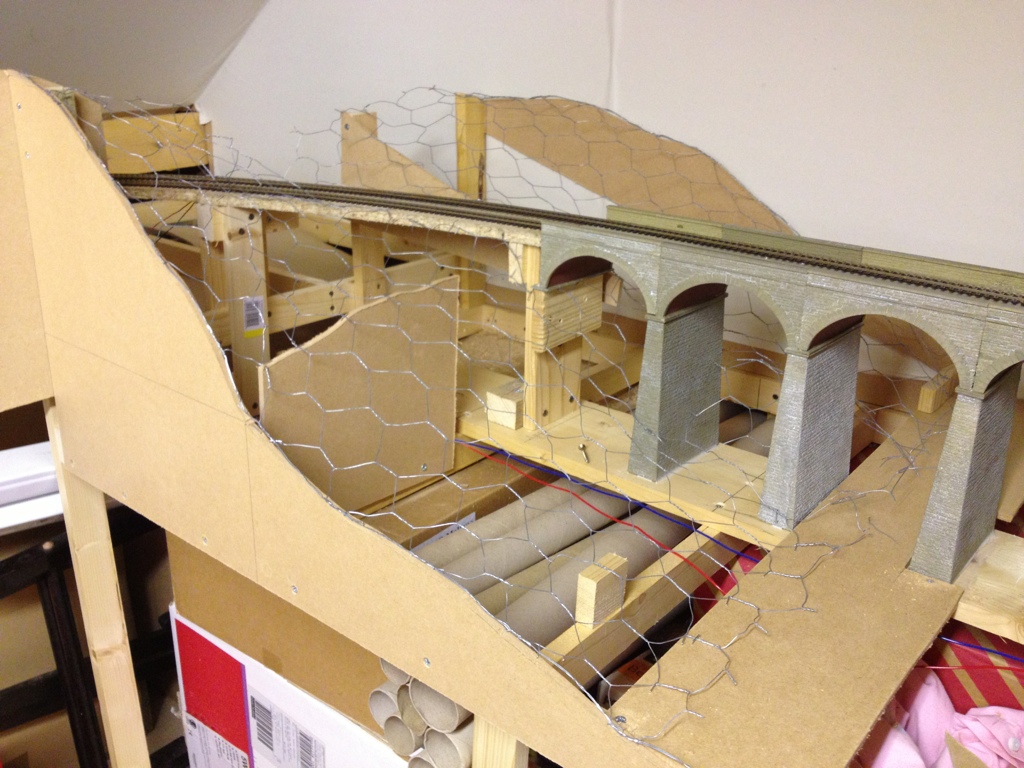
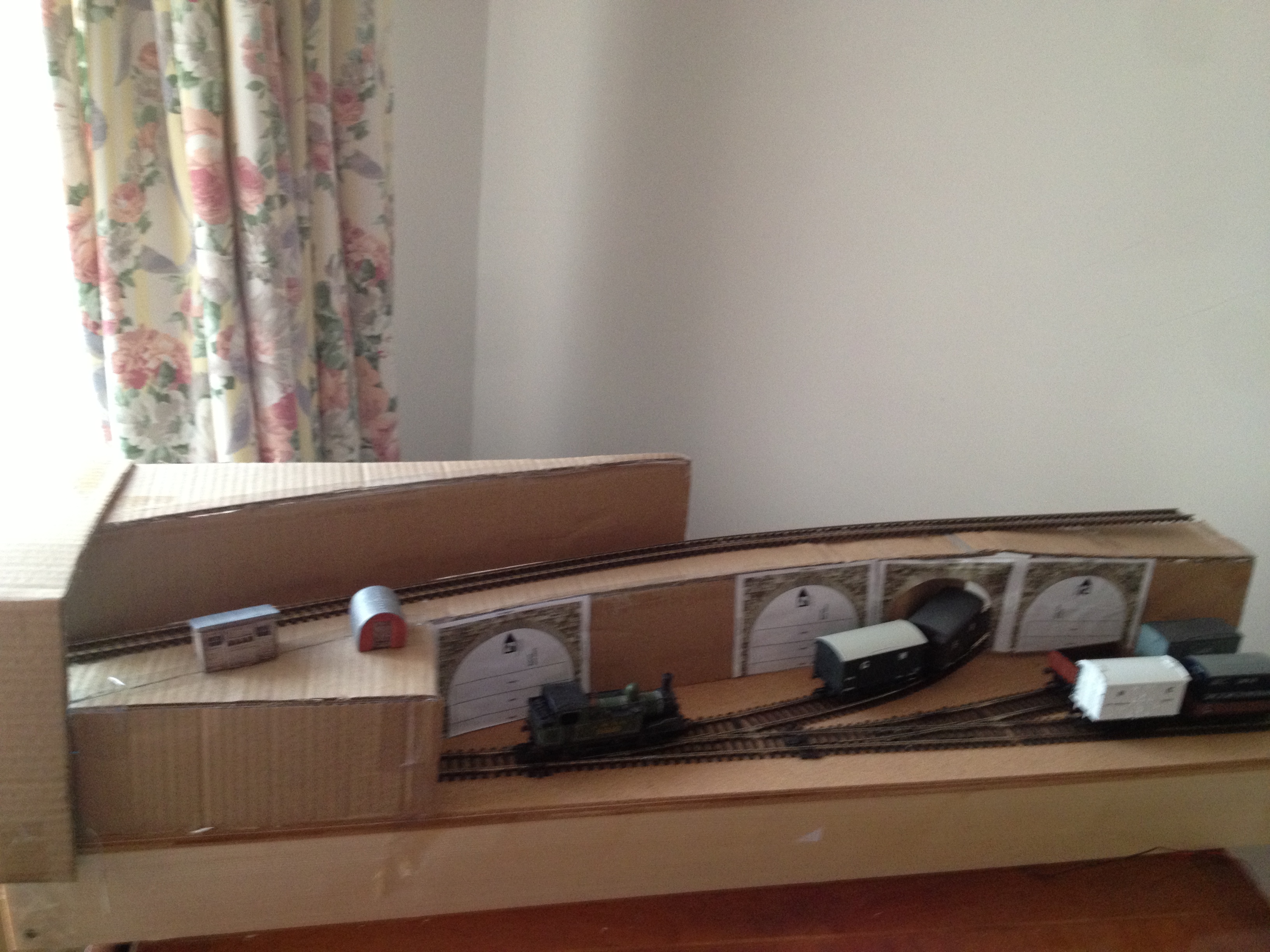
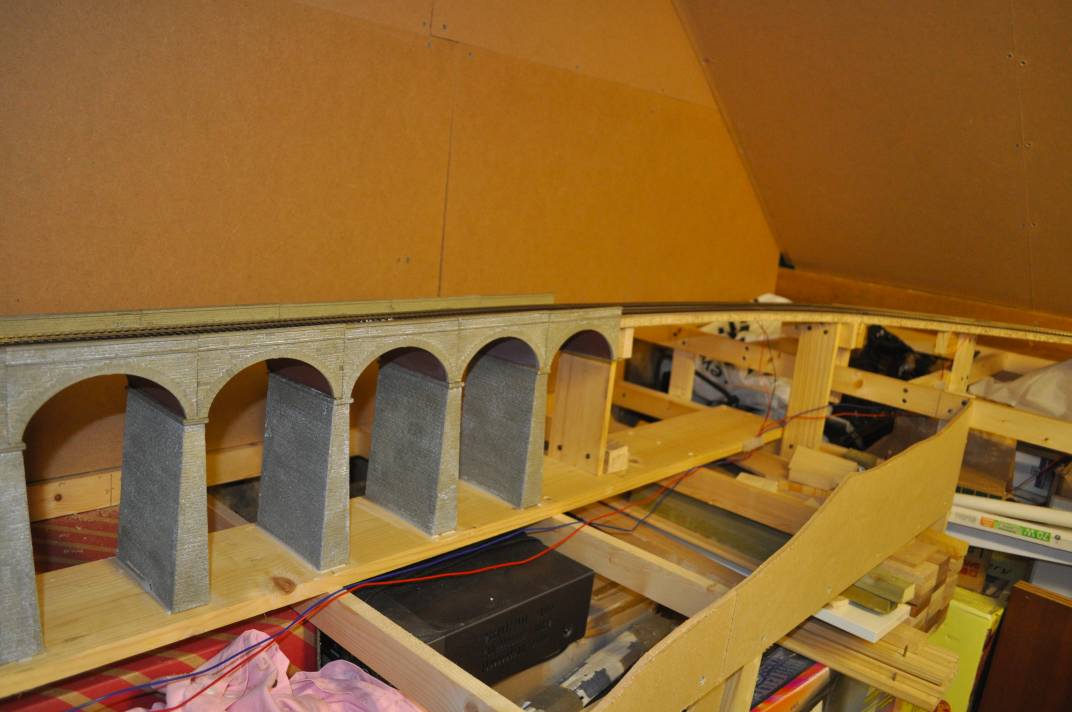
The blog has been very quiet of late regarding layout progress. As regular readers will be aware, the 2012 project is all about creating a diorama that has the feel of the Waverley route and features a viaduct based on Shankend, a siding and signal box based on Whitrope siding, and a tunnel mouth based on Whitrope tunnel. The intention is to make the scene as timeless as possible so that anything from LNER steam to a BR blue Deltic will look right passing through. There is a good reason for slow progress, work (the paid sort!) has taken me away from home Monday to Friday recently and trips to the railway room have been scarce. Some progress has been made on Rede Head Summit and viaduct. The walls and around the diorama have now been panelled, meaning that the bare beams of the loft are no longer visible and that area looks a great deal more like a railway room. A scenic break is also in place at one end of the scene, the part that will eventually become tunnel, and the profile of the landscape has been attached to the baseboard edge.

The viaduct is now syrrounded by panelled walls

I’m currently studying pictures of the portal to Whitrope tunnel with a view of building a near copy in miniature. The biggest challenge is going to be capturing the wild border fells and making the scenery rise high enough from the line to make the tunnel look necessary. This is a bit of a challenge when the distance from the end of the viaduct to the tunnel will only be about 3 feet.

Hopefully the landsacpe profile will be right for wild moorland

The time away from home and some idle evenings has allowed some thought on how the diorama might work operationally. One of my favourite layouts is Stoke Summit, I’ve spent hours watching it at a number of exhibitions, and I’m always drawn to it even though I’ve seen it all before. On analysis the thing that I like is simply watching full length main line trains going past in a very authentic setting. In effect its train spotting in miniature. This is the concept behind the diorama. Ultimately I want to be the signalman in Rede Head signal box, and my role is to accept trains and despatch them onwards to the next box, just as the prototype signalman would do. As I’m usually alone in the railway room without any other layout operators this is going to be an interesting challenge but I’m sure with full DCC operation through JMRI the required automation will possible. I simply need to work out how to do it!

The site for a replica of Whitrope Tunnel

The other side of the scenic break will have a bridge over the line

Gresley Full Brake arrives from Hornby

Finally it has arrived, the 61′ 6″ full brake from Hornby, in both LNER teak and BR Maroon. I had hoped that this would be available for Christmas, and was quite disappointed when it didn’t arrive under my tree. I bought the teak version last week and my initial conclusion is that the wait was worthwhile.

Hornby's excellent new Gresley 61ft 6in full brake

The full brake is a great addition to the LNER coaching stock list, and sits nicely alongside existing first, third, brake composite, buffet, and sleeping cars. High standards were set by all these coaches when first introduced, especially the teak versions where attention to achieving an authentic wood effect was second to none. The full brake has pushed these standards even further, and the only thing I have left to criticise is the price. I find it difficult to justify paying nearly as much for a coach as a locomotive.

There are several improvements over the previous Gresley coaches I’ve purchased, though I must admit the last buy was some time ago so some features may now be common across the range. The big improvement is the shape of the carriage side. Hornby have improved the profile of the tumblehome and this now looks pretty much spot on for the real thing. Also changed is the roof colour, which is no longer pure white but rather a very light grey, much more in keeping with something that has been out of the workshops for more than 5 minutes. The couplings are sprung loaded so that a smaller gap between carriages can be achieved while allowing some movement to go around reasonably tight curves without buffer lock.

Stocks of these excellent Gresley carriages should be good in most model shops. I sourced mine online from OnTracks, and I can highly recommend their service.

In conclusion, well done Hornby, even if the recommended price for a carriage has gone totally over the top at more than 40. I’m not sure how this can be justified in something that has no interior detail at all.

Bassetlaw Railway Society

I’m currently working for a client in Nottinghamshire, and this has me located in the Retford area most weeks. Last week I went along to the Bassetlaw Railway Society, and before the evening was out I’d paid my annual subs and became a member.

BNNRS seems like a great club with a bunch of very keen members. Plans are afoot to build a DCC layout based around a container depot and featuring the Heljan crane. I’m really looking forward to helping out as and when work commitments put me in Retford over the next few months. The concept of an exhibition layout built for the 21st century using the latest DCC ideas is one that interests me immensely.

The Bassetlaw (North Notts) Railway Society was founded in 1974 by a group of local enthusiasts interested in promoting railways in the North Nottinghamshire area. The club is based in Retford and has its clubrooms on platform 1 of Retford Railway Station. Once a month the club has formal meetings with a guest speaker. A list of forthcoming events can be found here.

The members of the club have interests which cover most aspects of railways both model and full size. Modeller’s within the society work in ‘Z’, ‘N’, ‘009’ ‘TT’, ‘00’ and ‘O’ gauges while other members collect historic Tri-ang, Hornby Dublo and Tinplate trains. The 70 strong membership has a variety of railway interests including live steam locomotive construction, steam, diesel & electric traction and railway photography.

While the society meets formally on the third Wednesday of each month in it’s club rooms on platform 1 of Retford railway station, the clubrooms are open most Mondays and Wednesdays for modelling activity. In addition, a selection of evening trips are usually arranged during the summer months, recent locations visited include The Stockholes Miniature Railway, Barrow Hill Diesel Depot and Doncaster Power Box. Following the sale of the club layout, ‘Idleforde Junction’ the modelling group are currently working on new exhibition standard model railways in ‘TT’, ‘OO’ and ‘O’ gauges. The society organises an annual Model Railway Exhibition in Retford’s Town Hall over the third weekend of November.

WHERE IS BASSETLAW??

Bassetlaw is an area in North Nottinghamshire, England, covering 245 Square miles. Situated between agricultural Lincolnshire and industrial South Yorkshire the district has two main population centres – the traditional market towns of Retford and Worksop. Bassetlaw is steeped in history, from the legends of Robin Hood to the story of the Pilgrim Fathers. William Brewster and Richard Clyfton left their homes and friends in Bassetlaw to sail on the Mayflower.

Bassetlaw dates back to 10th century Viking times and takes its name from the ancient Wapentake, largest of the mediaeval divisions of Nottinghamshire.

The Bassetlaw Railway Society draws members from a wide area and meets in Retford. One of the oldest boroughs in England, Retford’s royal charter was granted by Henry III in 1246. In 1766 the Great North Road was diverted through the town and in 1777 a canal opened linking Retford to the river Trent. The town became a railway centre in 1849.

Today, high speed diesel and electric trains of the Great North Eastern Railway and modern diesel units of Hull Trains speed through on their way to London, York, or Edinburgh. Some 16 trains in each direction stop at Retford, bringing the capital cities only 90 minutes, and 3 hours away respectively. Further east-west lines link Retford and Worksop with Sheffield, Lincoln, and Grimsby.

In May 1998 the Robin Hood Line reached Worksop, linking the town to Mansfield and Nottingham by rail for the first time since 1965.

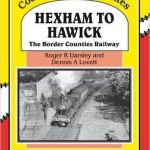
Hexham – Hawick

newly published through Middleton Press

this should be of great interest to waverley fans

The book covers the Border Counties Railway all the way from the junction with the Newcastle and carlisle Railway just west of Hexham all the way to Riccarton Junction where it met the Border Union Railway (better known as the Waverley Route). Also covered in some detail is Hexham Station and the Waverley line north of Riccarton through Whitrope Tunnel and Whitrope Summit to Hawick, although all of this repeats material already published in other books in this excellent series.

I’ve had a long running fascination of the North British Railway in Northumberland, and this book is a must for my personal bookshelf. The Rede Valley Line is based in part on the section of the Waverley covered in the book and I’m looking closely at the rich information supplied about Whitrope Tunnel and Siding. Readers of the blog will be aware that both of these are subjects of my own 2012 project for the layout

The coverage of the Border Counties Railway is to the usual high standard of this Middleton Press series, with trackplans and large scale maps of each station and key location on the Border Counties Railway, along with a good number of photos.

This book is a must for any modeller of the North British Railway in Northumberland, and the whole Middleton press series is a great modelling asset. All the Titles so far published are available from the Model Railway Bookstore. I’m hoping that titles covering the Newcastle to Berwick and the Wannie from Morpeth to Bellingham will be published soon.

Newcastle to Carlisle and the southern, Border Union section of the Waverley are already covered in the titles below.

Continue reading

Waverley Route featured in March Model Rail

The new edition of Model Rail is a Scottish special to coincide with Model Rail’s sponsorship of the Model Rail Scotland exhibition at SECC Glasgow on February 24-26.

Under the title “Taming the Border Lands” Ian Pritchard has written an extensive article on the Waverley Route and examines how it can be used as a prototype to influence a number of different model railway layouts. In typical Model Rail fashion the article covers the subject in depth over 4 pages and contains some very atmospheric photos of the line and information on the services that ran over it. As if we Waverley fans need any more persuading!

As well as a Scottish bias, March Model Rail has very much an ex LNER flavour, with the West Highland Line featuring strongly: David Harrison’s excellent N gauge Loch Oran and Kev Pearson’s DCC OO Loch Dour are two of the three featured layouts; and Ardlui forms the prototype for the regular Masterplan Model Rail feature. Theres also a feature on the final fling of Gresley’s A4s on the Glasgow to Aberdeen 3 hour expresses.

Model Rail editor Ben Jones shows how easy it is to model these classic trains. Everything needed is available off the shelf in both N and OO and it shows just how far the Hobby has progressed in recent years. When I started out modelling in the 70s the only way to do that would have involved extensive kit building, something I really don’t have time for any more.

No less than 5 separate Model Rail reviews feature LNER and ex LNER models, including the newly upgraded Bachmann A4 which receives good praise on all but price; the latest Hornby B1 Sir Harold Mitchell, which highlights Hornby’s attention to detail found only on engines overhauled at Cowlairs to work in Scotland and from Carlisle Canal shed. That makes this B1 a must for Waverley modellers even if it will need to be renumbered to represent one of the Carlisle engines.Reviews also cover coaches: the Hornby Gresley buffet car now appears in BR Inter City blue & grey livery; The release of Gresley non corridor brake thirds in both maroon and teak; and the release of all the other suburban coaches in an excellent teak finish. Its just a shame they didn’t make it in time to be under the Christmas Tree.

All in all another excellent issue of what I believe to be the best model rail magazine currently on the market. Time to take advantage of some of the great subscription offers to Model Rail that are around at the moment. Follow the link to the Great Magazines website I’m looking forward to my Model Rail turning up automatically each month with the postman from now on.

My only criticism of Model Rail is the disappearance of the regular DCC articles. It was these that made me a regular reader quite a number of years ago. Fortunately the other content is always excellent and I’ve really grown to like the practical workbench section that appears in Model Rail every month.

DCC Resources

Digital Command Control can be very straightforward, but can become complex quite quickly the more you try to do with it. The DCC pages in the various model railway forums are always busy, and I frequently answer questions there. Quite often I point folk to some of the resources that are about on the web, and thought it might be useful to reference these on the blog.  I’d highly recommend the following links:

DCC Concepts are a DCC supplier based in Australia, and while those of us in the northern hemisphere are unlikely to buy from them, the proprieter Richard Johnson has put together a great reference site which includes some invaluable information on choosing a DCC system.

Tony’s DCC Workshop hosted on the A19 model railway club’s site also contains useful practical information on point and crossing wiring.

I’d encourage anyone new to DCC to get a good book. The ones below are among the best

Modernisation plans for Newcastle Central Station

Without doubt Newcastle Central Station is one of the landmark railway stations in the British Isles. It is approached from the south by either one of two magnificent bridges across the river Tyne which afford splendid views down the river. The east end of the station, until the 1960s formed the city centre terminus for both north Tyneside and south Tyneside electric services, with these trains crossing over what was once the biggest railway crossing in the World.

I remember spending many an hour as a teenage train spotter in the central station capturing numbers of Deltics, Peaks, and Brush 4′s,  and watching the resident 03 diesel shunters go about their business along with the normal station pilot 31 411. The station then was quite run down and quite a lot of investment has been made in the intervening 30+ years to make the facilities in Newcastle quite pleasant. In still a regular visitor, but not as a train spotter, instead as a businessman boarding the East Coast 125 and 225 services to London most weeks. I do always carry a camera, and just occasionally it comes out to record the current railway scene.

225 arrives in Newcastle with the 09:31 to London on 5 April 2011

Soon things will be even better. Plans have been announced to substantially refurbish the station starting in mid 2012. The NE1 website carries the following announcement:

A £15 million transformation of Newcastle Central Station and surrounding area is now confirmed after the Government awarded an additional £4.95 million to business improvement district company, NE1 Ltd from round two of the Regional Growth Fund.

Newcastle Central Station is to be transformed into a magnificent sweeping gateway to the region with state of the art facilities for passengers, coaches, Metro, bus services and taxis with total confirmed investment now sitting at, at least £15m.

Jobs are expected to be created by the investment with more secured through the economic regeneration of the area.

The money comes days after the announcement that Network Rail has been awarded £8.6 million to transform the interior of Central Station.

Both NE1 and Newcastle City Council will augment these figures with their own additional funding contributions.

NE1 Ltd acted as a catalyst for the combined project, bringing together Network Rail and Newcastle City Council to make coordinated bids for different pots of funding.

The collaborative team worked hard for over 2 years to map out a visionary plan for the Station and its surroundings.  The money now secured will provide the key to unlock not only the major redevelopment of this immediate area but will also facilitate the regeneration of other areas around the station.

The Central Station is crucially placed within Newcastle to act as a gateway to the city and its redevelopment will have a major impact on other areas including the Quayside, Science Central, Grainger Street and Clayton Street, leading up into the commercial heart of the city.

The plans will seek to create a modern transport hub to provide enhanced links to key city centre locations through public realm improvements.

The work will celebrate the unique heritage status of the classical Grade I listed station, designed by John Dobson.

Network Rail plan to transform the station’s interior providing modern retail and leisure facilities, improved passenger waiting accommodation and toilets, better signage and alterations to the existing bridge, while adding lifts and escalators to make it easier to move around precious heritage listed building. There will also be improved glazed canopies to flood the station with natural light.

NE1 and the City Council plan to improve the area around the Central Station for pedestrians, drivers, cyclists and visitors to the city and help kick-start the economic regeneration of the area.

This will include upgrading pavements, remodelling the road layout and better signage to help improve the look and feel of the city, creating a clear and open pathway for pedestrians into the commercial heart of the city.

The redevelopment work will begin in mid-2012.

Deputy Chairman of NE1 Ltd, Gavin Black, said: “This is great news for Newcastle and the region, a major piece in this part of the regeneration jigsaw and offers huge potential to deliver significant and long lasting improvements citywide.  By catalysing the project we have been able to unlock collectively £15 million worth of investment for the city.  Credit is due to Newcastle City Council for committing tremendous resources to the project and Network Rail in recognising early on what could be achieved, along with Faulkner Brown who helped with the design concept.”

Barry Rowland, Chief Executive of Newcastle City Council and Clerk to the Tyne and Wear Integrated Transport Authority, said: “We have worked hard with our partners NE1 Ltd and Network Rail for almost two years to secure this range of funding and foster a shared vision for a regional transport hub that will create the conditions for accelerated regeneration of the areas surrounding the station.”

“We look forward to work starting next summer and progress being made on this important project.”

Great Railway Journeys – Bradshaw 1840

I’ve just caught up with Michael Portillo on BBC iplayer as he explores the borders, travelling south down the East Coast Main Line from Berwick to Newcastle, and then in the next episode from Newcastle to Carlisle.

The Royal Border Bridge, opened in 1850 gets a starring role, allowing the Newcastle & Berwick Railway which opened as far as Tweedmouth in 1847 to join with the line from Edinburgh south to Berwick which reached the river Tweed in 1846. George Stephenson’s magnificent viaduct finally allowed the complete east coast route to operate, though it would be a further 50 years before trains could make a proper through journey from London to Edinburgh without reversing at Newcastle.

The programme also features stops at Alnmouth and Morpeth, breifly deviating to visit Barter Books in the old station at Alnwick and the First Class Lounge from SS Olympic which now forms the dining room in the White Swan Hotel in Alnwick. There is also a quick trip to Ashington to see the world’s biggest pit village, and to the Mining museum at Woodhorn.

All in all a great perspective on the premier route between England and Scotland. Its a shame the Waverley isn’t open to see what Bradshaw had to say about the magnificent scenery through the Tweed valley to Galashields and then on to Carlisle via Hawick.

If you haven’t seen it yet go catch it on iplayer before it vanishes into the ether.

The 2012 Project

We are a week into 2012, the festive season is well and truly over, and New Year resolutions already broken. It is time to look seriously at some objectives for 2012.
On the Rede Valley, my 2011 aim was to have an  operational layout that could run trains. The main obstacle to this had been completion of the Viaduct, so that the continuous main line circuit could be completed. This was achieved, and by and large the layout is operational. There is still quite a lot of track to lay in order to complete the total plan: The main freight yard and the locomotive depot haven’t been started; there is an extra set of platform roads to lay through the main station, and the branch line out of Otterburn Junction into the military camp hasn’t even been planned.

With all this work to do, its difficult to know what to do next. All the work so far has been about building baseboards, laying track and connecting up the electrics. I’d rather like to have some variety, so the 2012 objective has to be about completing part of the layout scenically.

The intention is that the Rede Valley is a series of dioramas, with the flexibility that the time period in which each is set, and indeed the time of year each represents, is not always the same. For instance I intend to model Otterburn Junction in LNER 1930′s while the main station Monkchester will be set in the 50′s or 60′s. The easiest of these dioramas to complete should be the Viaduct section, as that will be modelled as an open moorland landscape, loosely based around the Waverley line through the Scottish Borders. So my 2012 objective for the layout is to complete the viaduct diorama to a standard that would be good enough for publication in the UK model press.

The pictures below illustrate the starting point for the project with the Wills Viaduct in place:

Rede Head Viaduct
Rede Head Summit

The objective is to capture the essence of Waverley, and there will be 4 main influences from the real railway:

  1. The viaduct at Shankend
  2. The signal box and siding at Whitrope Summit
  3. The famous curves and overbridge around Riccarton Junction
  4. Whitrope tunnel

To show what I’m after here is a series of links to images of the real railway:

 The portal of Whitrope tunnel

Shankend, with Peak, classic Waverley.

Shankend,again, with A2, Tudor minstrel

Brush 4 passing the signal box at Whitrope summit

A4, Whitrope Summit, clouds of smoke, and snow. What more inspiration do you need? Its almost tempting to set this part of the layout in mid winter

The section needs to have the feel of an open, uncluttered moorland landscape, and one of the challenges will be to represent the rugged border landscape.
A number of tasks need to be undertaken:

  • Finish the track work so that it runs faultlessly and lay the siding for the banking engines to reverse into having completed the tough climb to the summit
  • Panel the walls and ceiling around the section
  • Install trackbed and track behind the summit signal box that will eventually be hidden under the hillside. These will be needed to accomodate suburban trains arriving and departing from the main station area (this is to be built on the solid topped baseboard that can be seen in the corner of the Rede Head Summit photo above.
  • These train services will be fully automated so the hidden tracks will need to be fitted with Irdot infra red detectors both to stop the arriving trains and to record track occupancy of the hidden tracks.
  • I also intend to have block detection operating on the main lines so detectors will also need to be fitted to these while the underside of the trackbed is reasonably accessible.

So all in all thats quite a bit of work before I can even think about forming the basic shape of the landscape.

Some things have started though. A trip to B&Q resulted in the purchase of several sheets of MDF to panel the walls and ceiling, and also to form the landscape contours along the edge of the baseboards. At the same time a roll of chicken wire was obtained, this will be used to form the basic shape of the landscape and will be covered with plaster soaked sheeting to form the surface.

25 yards of Peco code 75 has also arrived to allow the track laying to take place. Hopefully this will provide sufficient to lay all the remaining areas of the layout, but hopefully doesn’t take the 5 years that the last pack took.

Now off to the railway room to start the weekend’s activities.